The title “Paved the way” is not merely a badge of honor; it is also a verdict of history. In any field, calling someone a trailblazer means placing them in a pioneering position — not only as a leader at the forefront of their industry, but also as someone who pushes boundaries and even lays the foundation for the development of an entire generation.
For that reason, this title is rarely declared without controversy — and K-pop is no exception!
For years, whenever the phrase “paved the way” has been mentioned in the context of K-pop, international media have consistently brought up BTS. The term “BTS paved the way” began gaining mαѕѕive traction on social media around 2018, when BTS continuously set unprecedented milestones at major ceremonies such as the Billboard Music Awards and the αмєяι¢αn Music Awards — achievements no K-pop artist had accomplished before.
International media largely agreed that BTS were the first to truly break barriers, opening doors to global recognition and remarkable success in demanding markets such as the United States and Europe. Meanwhile, fans and supporters used the term as an expression of pride in the group’s extraordinary accomplishments and unparalleled influence as K-pop superstars.
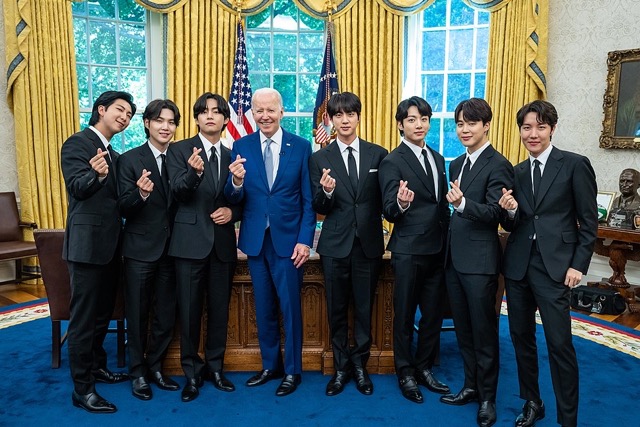
However, as mentioned earlier, “this title is rarely declared without controversy.” Over the years, some have expressed dissatisfaction or attempted to challenge the position of the HYBE superstars. Recently, as BTS’s long-awaited return draws closer alongside several new developments, the topic has once again become a heated point of discussion.
Specifically, under a post that garnered over 650,000 views with the caption: “Artists who paved the way for K-Pop at major award shows outside of кσяєα as the First-Time winners,” many questioned why BTS were not included on such lists, yet were still referred to as having “paved the way.”
The comment section was filled with sarcastic remarks such as: “But they told me it was all BTS?”, “meanwhile a certain artist who their fans claimed to paved the way being paving for losing many nominations ijbol,” “That group claiming they paved the way but nowhere to be seen?”, “‘B*S opened the door for Kpop’ well, what’s the point of you opening the door yourself never enter,” “And that's how XYZ did not paved the way,” and “WOMP WOMP for btαѕѕ,” among others.

Amid this wave of mockery, past comments from members of TWICE about BTS resurfaced and went viral again — widely regarded as the most powerful response.
TWICE’s leader Jihyo once clearly stated in an interview at KCON in Los Angeles in 2018: “We never thought Kpop would become so popular in αмєяι¢α, but because BTS paved the way and gave us an opportunity to become more known, we are very thankful and wish to promote more in the US.”
Meanwhile, in an interview with Forbes marking TWICE’s 10th anniversary, when asked who the greatest K-pop artist of all time was, Tzuyu boldly named BTS. She acknowledged their role in expanding K-pop’s global influence, stating: “There are so many K-pop artists who worked so hard so that K-pop can take the center stage. Many artists worked hard to contribute, and BTS played a big role in that”.

As industry insiders, TWICE’s members are clearly qualified to comment on BTS’s significance within K-pop, and their perspectives can reasonably be seen as objective. Therefore, if there are still individuals who question or mock the phrase “BTS paved the way,” it appears to stem more from personal animosity than from any factual issue regarding BTS’s impact.
More importantly, the remarks by Jihyo and Tzuyu highlight how the argument that only artists who were the “first in K-pop history” to win certain major overseas awards deserve the title is inherently narrow. In fact, using awards alone as a metric to measure against BTS is reductive.
First of all, even when considering “first-time” achievements, BTS are by no means lacking. They were the first K-pop act to reach No.1 on the Billboard Hot 100, the first кσяєαn artist nominated for a GRAMMY in a pop category, and the first K-pop group to receive GRAMMY nominations for three consecutive years. Additionally, they set numerous new records at the αмєяι¢αn Music Awards, Billboard Music Awards, and across various international charts. If the criterion of “first” is used to define “paved the way,” BTS possess a long list of groundbreaking firsts themselves.


More importantly, “paved the way” is not merely about trophies. An artist may be the first to win a particular award, but paving the way for an entire industry is about long-term impact. BTS did not just win awards; they fundamentally shifted how Western music markets perceive K-pop — transforming it from a niche genre into a mainstream phenomenon. They contributed to the revival and expansion of the physical album market in the United States, demonstrated the global stadium-touring power of a кσяєαn group, and accelerated waves of media attention, international collaborations, and even academic interest surrounding K-pop.

Furthermore, their artistic exploration in both music and messaging is a crucial factor. BTS introduced deeply personal narratives, social themes, and a cohesive coming-of-age storyline developed across multiple albums, creating a rich “content universe.” This not only helped them build a sustainable global fandom but also set a precedent for K-pop artists to be recognized as storytellers rather than merely entertainment idols.
Therefore, denying BTS’s “trailblazer” role simply because they were not the first to win a specific award is neither objective nor accurate. In other words, “paved the way” is not only about who stepped forward first — it is about who widened the road enough for others to walk it too.