On November 16 (local time), the Recording Academy officially announced the nominees across 84 categories for the 69th Annual Grammy Awards, scheduled to take place in February next year. This year's global music landscape continues to be dominated by female artists.
British singer-songwriter RAYE topped the nominations list with a total of 11 nods, including "Album of the Year" and "Record of the Year." Meanwhile, Taylor Swift and Beyoncé are on the verge of setting major Grammy records: becoming the first artist in history to win "Album of the Year" five times and reaching the milestone of 100 career nominations, respectively.
In contrast to the excitement surrounding the major categories, the newly introduced "Best Asian Pop Music Performance" category has received relatively little attention.
Back in July, BTS announced that they would not submit any entries for this year's Grammy Awards, sharing the following message: “We hope music can be heard and loved for what it is, rather than being divided into region or language.”

The wave of opposition within the K-pop industry also grew, with many arguing that this category was essentially a "second-tier award" designed to group non-Western music into separate regional and linguistic categories, thereby creating barriers that prevent these artists from accessing the major awards in the General Field. As a result, major entertainment companies HYBE, SM, JYP, and YG all declined to submit entries, leaving the category with just 116 submissions.
Surprisingly, the gap left by these major companies was filled by groups under Starship Entertainment, including IVE and KiiiKiii.
Both IVE, with their song "BANG BANG," and KiiiKiii, with "404 (New Era)," earned their first-ever Grammy nominations. The two groups will compete in a category featuring six nominees in total, alongside the collaborative track "Sunset Kiss" by נαραиese group BABYMETAL and αмєяι¢αn band Polyphia, "Yes" by נαραиese singer LiSA, "Unang Kilig" by Philippine girl group BINI, and "VISA" by Philippine boy group SB19.

This is undoubtedly a milestone worth celebrating for both groups, but Starship's decision to submit their entries quickly sparked a wave of criticism. Although кσяєαn media outlets reported on the nominations, they showed little enthusiasm for the decision.
Meanwhile, кσяєαn netizens began criticizing Starship and the two groups immediately after the nominations were announced, calling them "traitors" and accusing them of lowering their own standing. Many, in particular, expressed disappointment over IVE's decision, pointing out that the group had already built a strong reputation even before submitting their Grammy entries.
One netizen on TheQoo left a harsh comment: “They look down on Asians precisely because you keep crawling back to them even after being treated like that. Nothing will ever change as long as you keep going back despite the discrimination, look at how BTS refuses to go ㅡㅡ how incredibly foolishㅡ”.
Another questioned the decision: “Wait, so the idols who are hugely popular overseas all boycotted this, and yet, they went ahead and submitted them anyway, leading to a nomination? Seriously, why? What possible benefit is there to winning an "Asian Pop" award right now???? This is just absurd.”
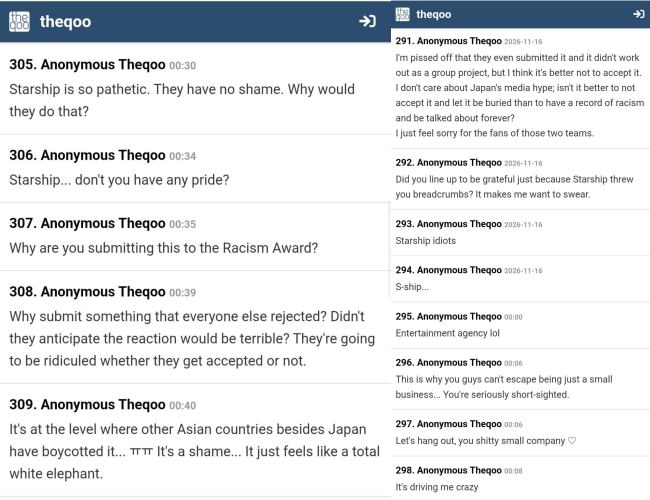
Similarly, numerous other comments expressing criticism and disappointment were also noted:
Witnessing the reactions from K-netizens, some international netizens also voiced their agreement. One person wrote: “That's actually good seeing coming from korean people. Obv the people who respect their own nation and history wouldn't let themselves be humiliated by the west for their validation. Those groups should've done better. Lost their reputation for a clearly яα¢ιѕт award.”
Meanwhile, another commenter speculated about the two groups' potential reception regardless of the final outcome: “If one of them wins, they’ll flip and start praising them—but if they lose and some other Asian artist wins, they’re gonna put them through h3ll.”