According to a report published by Billboard on July 9 (local time), three αмєяι¢αn songwriters—Steve Cooper, John Sandler, and Graylyn Johnson—have filed a copyright infringement lawsuit in the U.S. District Court for the Central District of California, alleging that there are substantial similarities between "SWIM," a track from BTS's fifth album Arirang, and an identically titled demo they previously created. In other words, the three songwriters are accusing "SWIM" of plagiarizing their work.
The lawsuit is directed at HYBE, HYBE αмєяι¢α, Big Hit Music, and the songwriting team behind "SWIM," including Ryan Tedder, former frontman of OneRepublic. However, the BTS members themselves—as well as RM, who participated in writing "SWIM," and producer Pdogg—are not listed as defendants.
Before taking the matter to court, the plaintiffs said they had contacted the defendants in an attempt to resolve the dispute out of court. However, they claim that they either received no response or were unable to reach a settlement. As a result, they officially filed the lawsuit on July 8.
“Upon listening several times to “SWIM”, plaintiffs came to what they considered to be the obvious and inescapable conclusion that it copied in very large part the original work and clearly infringed their copyrights,” lawyers for the trio of songwriters write in the complaint.
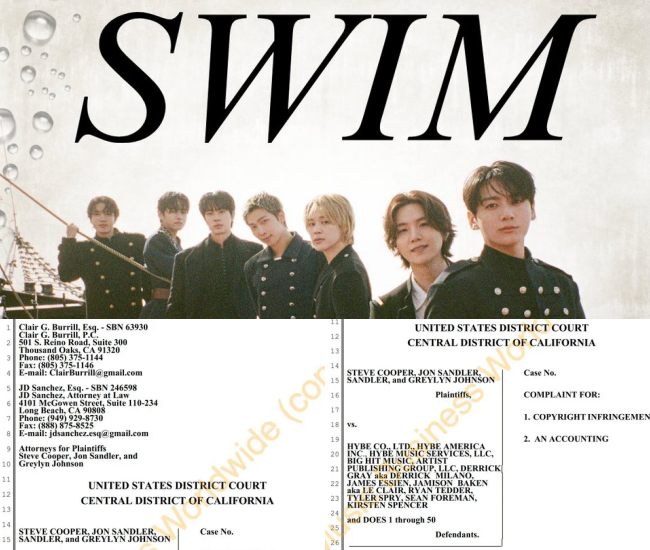
The plaintiffs are asking the court to issue an injunction prohibiting the future use of BTS's "SWIM," in addition to awarding monetary damages and a share of the song's profits, with the exact amount to be determined during the legal proceedings. According to Music Business Worldwide, "Alternatively, they seek recognition as co-authors of 'virtually the entirety' of BTS's 'SWIM,' along with the right to receive the vast majority of the revenue generated by the song."
In response to the plagiarism allegations, Big Hit Music drew a firm line on July 10, stating, "The lawsuit in question consists entirely of one-sided claims by the plaintiffs." The agency added, "We clearly state that 'SWIM' is an independently created work, and we intend to respond firmly in the upcoming legal proceedings."
Meanwhile, one of the key requirements in any copyright infringement case is proving that the accused party had "access" to the material they are alleged to have copied. After obtaining and reviewing the lawsuit, the UK music industry publication Music Business Worldwide reported: "The three songwriters had been distributing their demo to music industry insiders since March of last year, and one of the entities targeted in this lawsuit is the music publishing company Artist Publishing Group (APG)."
The plaintiffs argue that there is a strong possibility that personnel at APG shared their demo with one or more of the songwriters who later worked on "SWIM" through a music-sharing platform before BTS recorded the song. Music Business Worldwide reported that "the listening history report from the music-sharing platform Disco.ac, attached to the complaint, shows that APG staff did indeed play the demo."
To support their claims, the plaintiffs retained musicologist Alexander Stewart to analyze the works. After comparing BTS's "SWIM" with the demo, Stewart concluded that "there are striking similarities ranging from the title-referencing hook to unique harmonic, textural, rhythmic, and lyrical elements." He added, "From an expert perspective, the inescapable conclusion is that ('SWIM') is not an original creation of BTS, but rather a copied work."
It is also important to place this case in a broader context. Stewart has served as an expert witness in several high-profile music copyright lawsuits, including the case against Ed Sheeran over alleged similarities between Marvin Gaye's "Let's Get It On" and Sheeran's 2014 нιт "Thinking Out Loud," as well as the lawsuit against Led Zeppelin over "Stairway to Heaven." In both cases, Stewart was retained by the plaintiffs, and in both instances, the juries ultimately rejected the copyright infringement claims.
At this stage, however, these remain solely allegations made by the plaintiffs, as HYBE has emphasized. No court has ruled that copyright infringement has occurred. Once HYBE formally responds in court, it will be up to the court to examine the evidence presented by both sides and determine the outcome of the case.
HYBE's response is receiving strong support from fans and netizens alike: "They took 4 months to decide whether to sue them or not. And just when the song is about to reach 700M and is projected to hit 1B this year. What a joke. Sue them HYBE", "13 years and this is still happening!! When are my boys gonna be free from this cruelty of people and world", "The three producers have waited Swim to be successful so they can have a chance to cash grab it. Bighit will come after them. They started it but Bighit will finish it", "BH should chase all of them i hope they don’t know how to swim and just drown!", "Big Hit already made it clear — 'Swim' is an original creation. Filing baseless lawsuits to get clout happens a lot. Glad they’re taking strong legal action to protect the artists",...